
Bankruptcy Lawyers in Prescott, AZ

If you’re searching for bankruptcy lawyers in Prescott, AZ, you’re probably looking for two things at once: relief you can actually feel, and a plan that doesn’t leave you guessing. I’m Casey Yontz, an Arizona bankruptcy attorney with 18+ years of experience helping people protect what matters, stop collection pressure, and move forward with clarity.
This Prescott page is written for real people (not bots). You’ll find straight answers about timing, costs, common pitfalls, and what the process typically looks like—without promises or hype. Every situation is different, and the right next step depends on your income, assets, and goals.
Looking for a Bankruptcy Lawyer in Prescott?
When someone types bankruptcy lawyer Prescott into Google, they’re usually dealing with one (or more) of these: credit card lawsuits, wage garnishment threats, nonstop collection calls, medical bills, a vehicle that’s falling behind, or a paycheck that can’t keep up with Arizona living expenses.
Bankruptcy isn’t about “giving up.” For many people, it’s a legal reset button—used carefully—to stop the bleeding and rebuild stability. The key is choosing the right chapter and filing at the right time, with the right information on the paperwork.
What Bankruptcy Can (and Can’t) Do
- Stop collection activity: Bankruptcy can trigger the automatic stay, which typically stops most collection calls, lawsuits, and garnishments.
- Create a structured plan: In some cases, a repayment plan under chapter 13 can help you catch up on arrears over time.
- Address secured debts: Depending on your situation, you may be able to keep a vehicle or home and deal with missed payments.
- Deal with tax/priority issues carefully: Some debts have special rules (recent taxes, support obligations, certain judgments). We’ll identify what’s realistically on the table.
Bankruptcy also has limits. It can’t fix the underlying budget overnight, it doesn’t erase every type of debt, and it can create risk if you file without understanding exemptions, transfers, or timing. That’s why a careful review matters.
Choosing Between Chapter 7 and Chapter 13 in Prescott
Most people are really trying to solve one of a few problems: stop a garnishment, deal with a lawsuit, keep a car, catch up a payment, or lower the monthly pressure. The chapter that fits depends on your goals and your overall financial snapshot.
Chapter 7
Often explored when the priority is relief from unsecured debt and the numbers fit. It tends to be the simpler path, but planning and timing still matter.
Chapter 13
Often explored when you need time and structure—like catching up on certain payments or protecting important assets with a plan.
If protecting property is a bieg concern, exemptions can be a key part of the conversation. For the deep details and current limits, start here: Arizona bankruptcy exemptions.
Chapter 13
Chapter 13 is a court-supervised repayment plan (usually 3–5 years). It’s commonly used when someone needs time to catch up on a home or vehicle, has income above certain limits, or has assets that need added protection. Exemptions still matter, but in a different way: they can affect how much must be paid to unsecured creditors in the plan.
Bankruptcy Court and 341 Meetings for Prescott Residents
Prescott bankruptcy cases are handled in the United States Bankruptcy Court for the District of Arizona. Yavapai County cases (including Prescott) are assigned to the court’s Prescott office code.
Where Prescott Residents Attend 341 Meetings
The 341 meeting (also called the “meeting of creditors”) is not a courtroom hearing and it is typically not held in front of a judge. It’s usually a short, scheduled meeting run by the trustee where you answer basic questions under oath about your paperwork, income, assets, and debts.
How 341 meetings work now: In Arizona, most chapter 7, chapter 12, and chapter 13 341 meetings are conducted virtually via Zoom. The Meeting ID / passcode (and phone audio option, if needed) are usually tied to the assigned trustee and appear on your official notice.
You’ll receive an official court notice after a bankruptcy case is filed. This notice includes key details like your case number, the trustee information, and instructions for attending the 341 meeting. See the official bankruptcy notice forms (Official Form 309 series) so you know what the notice looks like and where the meeting information appears.
For additional context on what to expect at the meeting, the U.S. Trustee Program explains how 341 meetings work and why the instructions on your notice matter. U.S. Trustee Program: Section 341 Meeting of Creditors.
Before Zoom: 341 meetings were typically held in-person at designated meeting locations. Today, the default format is usually remote unless the trustee’s notice says otherwise.
- Look at your official notice: It will show the date/time and the instructions to join (Zoom link/Meeting ID, passcode, and any audio-only details).
- Have ID ready: Be prepared to show government-issued photo ID and proof of your Social Security number (the trustee’s office will specify exactly what they want and how).
- Choose a quiet spot: Good audio matters. Treat it like an appointment—log in early and avoid background noise.
What Bankruptcy Court Serves Prescott?
Prescott residents file under the District of Arizona, and Yavapai County cases are assigned under the court’s “Prescott” office code. Filing and payment can generally be handled through the court’s official channels, and the court also has listed hearing locations around the state.
If Your Case Needs a Court Hearing
Most bankruptcy cases don’t require you to appear in a courtroom. That said, some cases do involve hearings—more commonly in chapter 13, where issues like motions to lift the automatic stay, plan objections, or other contested matters can come up.
In Arizona, many hearings are conducted remotely (Zoom/telephonic) under the court’s procedures. If a hearing is set in your case, you’ll receive a notice that tells you exactly how to attend and whether it’s remote or in-person.
If an in-person appearance is required, the notice will list the location. For northern Arizona matters, a common hearing site is the Flagstaff hearing location. Depending on the judge and the issue, some proceedings may also be set in thePhoenix courthouse. Always rely on your notice of hearing for the authoritative location and instructions.
- Read the notice line-by-line: It will say whether you appear by Zoom, telephone, or in person.
- Test your connection ahead of time: If the hearing is by Zoom, check your camera/mic and join a few minutes early.
- Plan travel only if the notice requires it: If you must attend in person, arrive early, bring the hearing notice, and expect security screening.
Note: Court procedures can change. Your trustee’s notice for the 341 meeting and your court notice of hearing control the time, format, and location for your specific case.
Local Insights: Prescott Life and Common Bankruptcy Pressure Points
Prescott has its own rhythm. Downtown around Courthouse Plaza and Whiskey Row stays busy, and many residents balance a mix of local work, commuting toward Prescott Valley, and seasonal income patterns. We also see a lot of long-time homeowners and retirees—people who may have equity concerns, fixed-income budgeting issues, or medical-related debt that snowballed quickly.
In practical terms, Prescott bankruptcy filings often turn on questions like: “Can I protect my home equity under Arizona exemptions?” “What happens if I co-signed for a family member?” “Can I keep my truck if I’m behind?” “Will a credit card lawsuit turn into a wage garnishment?” These are the kinds of nuts-and-bolts issues we focus on from day one.
How We Approach Prescott AZ Bankruptcy Attorneys Work
If you’re comparing Prescott AZ bankruptcy attorneys, look for someone who’s comfortable with details and explains the “why,” not just the “what.” My approach is simple:
- Listen first: What’s the real problem—lawsuit pressure, foreclosure risk, vehicle repossession, or just drowning?
- Map the risks: Equity, transfers, tax refunds, recent payments to family, business income, and timing.
- Choose the chapter that fits: The “best” chapter is the one that matches your goals and your numbers.
- Make it manageable: Clear checklist, clear timeline, and no mystery about what happens next.
We’re Phoenix-based, and we help people across Arizona, including Prescott. Consultations can be handled remotely as an option, and if an in-person meeting is important for your situation, we can talk through what makes sense.
What Clients Say About Our Prescott Bankruptcy Lawyer Services
If you’re researching bankruptcy lawyers in Prescott, AZ, it helps to hear from real people who have been through the stress and uncertainty that debt can bring. Below are a few reviews from clients who worked with us.
“Great empathy… walked me through the process.”
Casey is a great lawyer that shows great empathy — I was shaken and terrified before the call but Casey walked me through the process and reassured me endlessly. Throughout the conversation, he made me feel comfortable and confident. I know I am in good hands because of him. He practically saved my life. I thank him for giving me a new start and all that he has done for me. I highly recommend him, best lawyer in THIS world!
— Tiffany T.
“Super knowledgeable and caring.”
Casey is a life saver. I did not know what to do or where to turn, but Casey had the answers. Super knowledgeable and caring. If you or anyone you know is in a financial bad place in life or you are helping to clean up an elder parent's affairs, call this office. Don't wait!!!
— Bonnie Y.
“Helpful and hardworking.”
Casey was helpful and hardworking to resolve our legal needs. We are 100% satisfied and would recommend him to our family and friends.
— Shea K.
Looking for a Prescott AZ bankruptcy lawyer who treats you like a person and explains the process clearly? We’re here to help you understand your options and choose a path forward that fits your situation.
Serving Prescott and Nearby Areas
If you’re looking for a Prescott AZ bankruptcy lawyer, we can help whether you live in the heart of town or in nearby communities. Many clients prefer to handle meetings by phone/video as an option, and we also discuss in-person options when it’s helpful.
- Downtown Prescott / Courthouse Plaza area
- Williamson Valley
- Thumb Butte area
- Prescott Lakes
- Hassayampa Village area
- Prescott Valley
- Chino Valley
- Dewey-Humboldt
- Mayer / Paulden (case-by-case)
Practical Next Steps If You’re Considering Bankruptcy
- Make a quick list of debts: credit cards, medical bills, personal loans, lawsuits, tax notices, and secured debts.
- Know your income picture: last 6 months of pay stubs (or self-employment records) usually tells the story.
- Don’t panic-move assets: Transfers, “selling” to family, or draining accounts can create avoidable problems.
- Talk before the crisis date: If there’s a lawsuit hearing, garnishment start date, or repossession risk, timing matters.
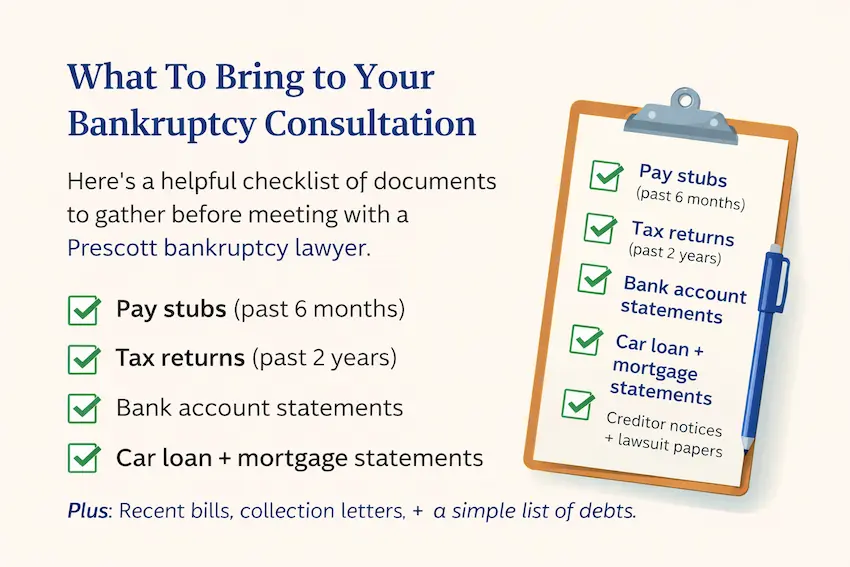
Document Checklist for Your Bankruptcy Consultation
If you’re thinking about bankruptcy, the easiest way to get clear answers fast is to gather a few key documents ahead of time. This checklist covers the most common items we’ll review in a Prescott bankruptcy lawyer consultation.
Talk With a Prescott Bankruptcy Lawyer Without Pressure
If you need a Prescott bankruptcy lawyer, the goal of a consultation is simple: get your facts on the table, understand your realistic options, and leave with a plan. No legal guarantees—just experienced guidance and a clear next step.
Arizona Bankruptcy Guidance and Resources
Practical, plain-English guides for people across Arizona—built by a Phoenix-based bankruptcy law firm to help you understand your options and take the next step with confidence.
Prescott Bankruptcy FAQs
What should I expect when I contact a Prescott bankruptcy lawyer for a consultation?
A consultation should feel practical: we identify the pressure you’re facing (lawsuit, garnishment, vehicle issues, medical debt, or overwhelm), review your income and a basic budget snapshot, and talk through your assets and goals. From there, we explain whether bankruptcy is likely to help, which chapter is usually worth comparing, and what timing or paperwork decisions matter most. The goal is clarity and a realistic next step—not hype.
Will bankruptcy stop creditor calls, lawsuits, and wage garnishments in Prescott, AZ?
In many cases, filing bankruptcy triggers an “automatic stay” that pauses most collection activity, including many lawsuits and wage garnishments. Timing can matter if you have a court date, a garnishment start date, or a repossession risk, so it helps to share any lawsuit or garnishment paperwork as early as possible. Some situations have exceptions, so a quick review is the best way to understand what applies in your specific case.
How do chapter 7 and chapter 13 work for Prescott residents?
Prescott residents usually compare chapter 7 and chapter 13 based on the goal. chapter 7 is typically faster and is often used to address unsecured debts like credit cards, medical bills, and many personal loans (if the eligibility numbers line up and assets can be protected with exemptions). chapter 13 is a court-approved repayment plan (often 3–5 years) that can be used to catch up on certain obligations or protect assets through a structured plan. The right fit depends on income, assets, equity, and what you’re trying to protect.
Where do Prescott residents attend the 341 meeting of creditors?
The 341 meeting (meeting of creditors) is usually a short, scheduled appointment with the trustee to confirm basic information from your bankruptcy paperwork. In Arizona, many 341 meetings are commonly handled remotely (often by Zoom or similar procedures listed on your official notice). After your case is filed, you receive a court notice with your trustee information and specific instructions for the date, time, and how to attend—so your notice controls the details for your case.
What documents should I gather before speaking with a Prescott bankruptcy attorney?
You don’t need a perfect folder to start, but a few items help you get clear answers faster: recent pay stubs (or income records if self-employed), a basic list of creditors/collections, any lawsuit or garnishment paperwork, and your housing/vehicle payment details. If you have recent tax returns and bank statements, those can also help with planning and timing. If you’re facing a deadline, mention it—deadlines can change the best next step.
Bankruptcy Help Across Arizona
We work with individuals and families in the Phoenix metro area and in communities across Arizona. In office, phone and virtual appointments are available. Choose a city below to find local bankruptcy guidance, common issues we often see in that area, and practical next-step resources.