
Chapter 7 Bankruptcy in Arizona

Why You Can Trust This Guide
- Arizona-focused, attorney-reviewed: Built from real Arizona chapter 7 filing issues—what you can keep, who qualifies, and what to watch out for—reviewed by an Arizona bankruptcy attorney with 18+ years of experience.
- Primary sources are linked on this page: We link directly to the Arizona exemption statutes (A.R.S.) and U.S. Trustee Program means test resources so you can verify key rules and numbers.
- Clear scope, plain-English explanations: We cover the common path for consumer cases and flag areas where results can vary (like equity, taxes, recent transfers, or unusual income) so you know what’s “normal” and what needs a closer look.
- Practical, decision-first structure: The goal is to help you make the next right move—understand eligibility, protect what matters, and avoid preventable mistakes before filing.
If you’re researching chapter 7 bankruptcy Arizona, you’re probably trying to answer a few practical questions: “Can I erase credit cards and medical bills?”, “Will I lose my house or car?”, and “Do I qualify under the means test?” This guide walks through how bankruptcy chapter 7 in Arizona works in plain English, what the process looks like in real life, and the big decisions people usually face before filing.
What Chapter 7 Bankruptcy Does (and Does Not) Do
Most people looking at chapter 7 want the same bottom-line answers: Will this stop collection pressure? Can I keep my house and car? Which debts actually go away? Chapter 7 is designed to give eligible filers a fresh start by wiping out many unsecured debts—usually without a long repayment plan.
What Chapter 7 Typically Does for People in Arizona
- Stops most collection activity quickly: In most cases, filing triggers the “automatic stay,” which typically pauses collection calls, lawsuits, garnishments, and many other collection actions while your case is pending.
- Erases many unsecured debts: Most people use chapter 7 to wipe out the kinds of debts that don’t have collateral attached.
- Moves on a fairly predictable timeline: Many cases follow a simple path: file → 341 meeting → discharge (in eligible cases).
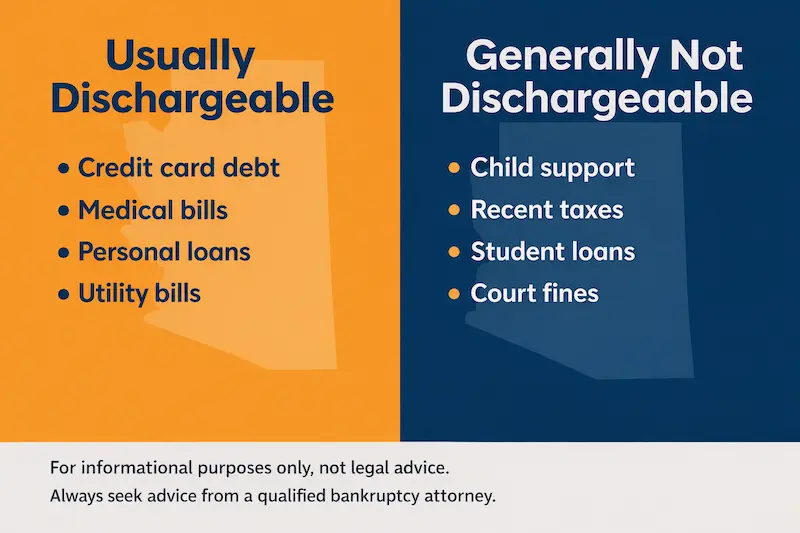
Debts Chapter 7 Commonly Discharges
- Credit card debt
- Medical bills
- Personal loans and many signature loans
- Many older utility balances and collections
Important Limits to Know Up Front
Some obligations typically survive bankruptcy, even after a chapter 7 discharge. The goal isn’t to discourage you—it’s to help you set accurate expectations before you file bankruptcy chapter 7 Arizona.
- Support obligations: child support and spousal maintenance generally do not go away.
- Most student loans: many require a separate legal standard in a separate proceeding to discharge.
- Some taxes: especially recent taxes or taxes tied to missing filings can be complicated.
- Fines, restitution, and certain “bad acts” debts: some debts tied to fraud or intentional harm can be challenged and may not be discharged.
Common Scenarios Arizona Filers Ask About
Scenario 1: “I Want to Keep My Car”
Keeping a car in chapter 7 often comes down to two practical questions: (1) whether there’s meaningful equity, and (2) whether the loan situation is workable going forward.
- Equity check: estimate the car’s value minus the loan balance. If there’s little to no equity (or it’s protected), car-retention is often straightforward in many consumer cases.
- If you’re behind on payments: chapter 7 usually doesn’t provide a built-in long-term catch-up plan. If the goal is to catch up over time, it’s often smart to compare a repayment plan under Chapter 13 bankruptcy in Arizona.
If the car is critical for work or family logistics, it’s worth doing a quick equity estimate and mapping out the payment plan before you file.
Scenario 2: “I’m Behind on My Mortgage and Want to Keep the House”
Chapter 7 can wipe out unsecured debts and may create short-term breathing room, but mortgage arrears are different. If your main goal is to keep the home, the key question is whether you need time to catch up.
- Short-term pause: filing often triggers the automatic stay, which can temporarily pause foreclosure activity while the case is pending.
- Catch-up plan: if you need a structured way to repay arrears over time, that’s typically when it makes sense to look closely at chapter 13 bankruptcy in Arizona, which is designed around a court-approved repayment plan.
If you’re trying to keep a home, the best next step is usually to estimate the arrears, confirm whether you can resume normal payments, and then choose the chapter that fits that plan.
Scenario 3: “I’m Worried About What I Can Keep”
This is the most common fear people have about chapter 7. In many consumer cases, people keep their typical household property—but the correct answer depends on equity and how Arizona’s exemption rules apply to your specific assets.
If you want the full, Arizona-specific exemptions breakdown (categories, common issues, and the practical way lawyers analyze “keep vs. risk”), start here: Arizona bankruptcy exemptions guide.
If you’re close to the line on a home, vehicle, or other higher-value property, it’s worth getting an Arizona bankruptcy attorney to review the numbers before you file—especially equity estimates, which Arizona protections apply, and any timing issues that could create extra trustee questions. A quick review can prevent unpleasant surprises.
If you’d like, tell us what’s going on and we’ll help you identify the best next step.
For informational purposes only, not legal advice. Always seek advice from a qualified bankruptcy attorney.
What Happens to Your Property in an Arizona Chapter 7 Case
A chapter 7 case is administered by a trustee, who reviews the paperwork, looks for non-exempt value, and can administer non-exempt assets if it makes financial sense for creditors. Most consumer chapter 7 cases are “no-asset” cases, meaning the filer keeps their protected property and there’s nothing to liquidate.
Plain-English Property Rule: Equity + Protection Rules
In chapter 7, property questions usually come down to equity and whether Arizona’s protection rules cover that equity.
- Equity is generally the value of something minus the loans against it (for example, home value − mortgage balance).
- Protection rules are the Arizona laws that can shield certain equity or property in a bankruptcy case. The details matter, so it’s worth using a dedicated exemptions reference when you’re making decisions.
For the full Arizona-specific breakdown (categories, common issues, and how it’s applied in real cases), use our Arizona bankruptcy exemptions guide.
Two High-Level Examples People Ask About
- Home equity (homestead): Arizona has a homestead protection rule for a primary residence. Source: A.R.S. § 33-1101.
- Vehicle equity: Arizona has a protection rule for equity in a motor vehicle. Source: A.R.S. § 33-1125.
If property is your main concern, the safest next step is to estimate equity and confirm how the Arizona rules apply to your specific assets before you file.
Do You Qualify? The Chapter 7 Means Test in Arizona
The chapter 7 means test is the eligibility screen most people think of when they search chapter 7 bankruptcy Arizona. Here’s the practical way to approach it so you can get a reliable “likely yes / maybe / likely no” answer before you go too far down the road.
Quick Checklist: What to Gather Before You Run the Means Test
- Pay stubs (or income records) for the last 6 full calendar months: the means test uses a lookback window, not just your current paycheck.
- Your most recent tax return(s): helpful for confirming income sources and spotting one-time items (bonuses, contract work, distributions).
- A list of everyone in your household and who you support: household size can change the median threshold and the analysis.
- Big monthly obligations: mortgage or rent, car payments, child support, and any unusual expenses that might need documentation.
Most people qualify for bankruptcy chapter 7 in Arizona in one of two ways:
- You’re under Arizona’s median income threshold for your household size, based on your average gross income over the last six full calendar months.
- You’re over median, but you still pass the means test after allowed deductions (certain living expenses and other deductions the bankruptcy forms apply).
Being above the median doesn’t automatically mean you can’t file. It usually means you have more math to do before you know whether chapter 7 is available to you.
Try Our Chapter 7 Means Test Calculator
If you want to estimate whether you may qualify for chapter 7 bankruptcy, use our chapter 7 means test calculator. It walks you through income, household size, deductions, and estimated disposable income so you can get a clearer starting point.
The calculator is educational only and is not a final determination of eligibility, but it can help you understand whether the means test may be an issue in your Arizona chapter 7 case.
Chapter 7 Means Test Calculator | Yontz Law, PLLC.
Educational estimate only. This Chapter 7 means test calculator is not legal advice, does not create an attorney-client relationship, and cannot account for every legal nuance. Attorney review may still be necessary.
Step 1: Initial Screening
If filing alone, household starts at 1. If filing jointly, household starts at 2. Add only additional dependents here.
Consumer debts are usually personal, family, or household debts.
Median-income dataset effective April 1, 2026. IRS/local standards preset date: Configurable - update with current IRS + USTP data. Presumption thresholds: $10,025 and $16,700 (60-month).
Understanding Your Means Test Calculator Result
The calculator above is designed to give you a practical starting point. It looks at the same basic issues that matter in a chapter 7 means test: household size, income, allowed deductions, and estimated disposable income. Your result is not a final legal determination, but it can help you see whether chapter 7 may be available or whether the numbers need a closer review.
What the Calculator Is Really Checking
- Your household size: this affects the Arizona median income number used in the first part of the test.
- Your average income: the means test generally looks at the last 6 full calendar months before filing, not just your current paycheck.
- Allowed deductions: some deductions are based on actual expenses, while others use standard amounts from the bankruptcy forms.
- Estimated disposable income: this helps show whether the means test may create a problem for chapter 7 eligibility.
Step 1: Compare Your Income to Arizona’s Median Income
The first part of the means test compares your household income to Arizona’s median income for your household size. If your average gross income is below the median, you usually pass this first screen. That does not mean every issue is resolved, but it is often a strong sign that chapter 7 may be available.
The key is using the right income period. The means test generally uses the last 6 full calendar months before filing. For example, if you file in July, you usually look at January through June—not the last 6 paychecks and not the current month.
Common Income Mistakes to Avoid
- Do not use only your current paycheck if your income has recently changed.
- Do not forget overtime, bonuses, commissions, side work, or business income received during the lookback period.
- Do not assume a recent income drop automatically fixes the means test. Timing and documentation can matter.
Arizona Chapter 7 Income Limits
The table below shows Arizona’s current median income figures for common household sizes. These numbers are useful because they are the first comparison point in the chapter 7 means test. If your household income is above the number listed, you may still qualify, but you usually need to complete the deduction portion of the test.
| Household Size | Annual Median Income (USD) |
|---|---|
| 1 | $73,935 |
| 2 | $89,027 |
| 3 | $104,965 |
| 4 | $121,174 |
| Add $11,100 for each person over 4. | |
These figures reflect chapter 7 bankruptcy Arizona income limits effective for cases filed on or after April 1, 2026, based on the U.S. Trustee Program’s median income table. These numbers are updated periodically, so always verify the most recent table here: UST Median Family Income by Family Size.
Step 2: If You Are Above Median, Deductions Matter
Being above Arizona’s median income does not automatically mean you fail the means test. It usually means the second part of the analysis becomes more important. This is where allowed deductions are applied to estimate whether you have enough disposable income to repay a meaningful amount of unsecured debt.
This is also where the calculator can be especially helpful. It gives you an organized way to enter deductions and see how the result changes. Still, the means test can be sensitive to details, especially if you have irregular income, support obligations, secured debt payments, taxes, or unusual expenses.
Why Your Calculator Result May Need Review
- Some expense categories use standard amounts, not necessarily what you actually spend.
- Household size can be more complicated than simply counting everyone under one roof.
- Self-employment income, bonuses, commissions, and overtime can change the result.
- A recent income drop may help, but timing and documentation can affect how the means test is completed.
For an official overview of how the U.S. Trustee Program approaches means testing, including the data sources and forms involved, see U.S. Trustee Program: Means Testing.
When to Get Help With the Means Test
- You’re close to the median and you’re not sure which 6-month period applies.
- You have self-employment, commissions, bonuses, or irregular income.
- You recently had a job change, reduced hours, medical leave, or a major income drop.
- Your situation involves support payments, unusual expenses, or anything you think a trustee might question.
If you’re on the line, or you’re not sure how household size, overtime, self-employment, or irregular income should be handled, that’s one of the situations where speaking with an arizona chapter 7 bankruptcy lawyer can save you time and help you avoid filing mistakes.
How to File Bankruptcy Chapter 7 in Arizona: The Real-World Steps
If you’re considering filing for bankruptcy chapter 7 in Arizona, this is the typical roadmap. The exact timing can vary, but these are the steps most cases follow.
In most cases: gather documents → credit counseling → file → 341 meeting → debtor education → discharge.
- Get organized: Gather pay stubs (last 6 full months), tax returns, bank statements, a creditor list, and a simple monthly budget.
- Take the required credit counseling course: This is a pre-filing requirement and must be completed before you file. Timing matters, so don’t take it too early.
- Prepare and file the petition and schedules: Accuracy matters. Missing creditors, incorrect values, or incomplete disclosures can cause delays—or worse.
- The automatic stay begins: Filing typically pauses most collection activity (calls, lawsuits, garnishments) while the case is pending.
- Attend the 341 meeting: You’ll answer trustee questions under oath about your paperwork. It’s usually brief, but preparation and honesty are essential.
- Complete the debtor education course: This is the post-filing course required to receive a discharge. Missing it can delay or prevent discharge.
- Receive the discharge (if eligible): Many cases receive a discharge a few months after filing if there are no objections, unusual issues, or missing documents.
When an Arizona Chapter 7 Bankruptcy Lawyer Helps the Most
You can file on your own, but chapter 7 is easiest when your situation is simple and your paperwork is clean. If you’re dealing with anything that could raise questions—like home or car equity, recent transfers, irregular income, tax issues, or a prior filing—getting an Arizona bankruptcy attorney involved early can prevent delays and mistakes.
- Confirm eligibility before you file: run the means test correctly and spot issues that could lead to dismissal or unnecessary complications.
- Protect what matters: identify where equity exists and apply the Arizona protection rules appropriately so you don’t walk into avoidable property problems.
- Stay ahead of trustee questions: prepare documentation for anything that commonly triggers follow-up (income changes, transfers, unusual deposits, tax refunds, or business income).
If you’re deciding between chapter 7 and a repayment plan under chapter 13, you can compare approaches here: Chapter 13 bankruptcy in Arizona.
If you’d like, tell us what’s going on and we’ll help you identify the best next step.
For informational purposes only, not legal advice. Always seek advice from a qualified bankruptcy attorney.
Downsides and Tradeoffs to Consider Before You File
Chapter 7 can be a powerful reset, but it’s not a magic wand. The best outcomes usually come from going in with clear expectations—what chapter 7 fixes, what it doesn’t fix, and what decisions you may still have to make after filing.
How to Think About Tradeoffs
Ask yourself two questions: (1) What problem am I trying to solve right now (lawsuits, garnishment, impossible payments, stress)? (2) What do I need to protect (housing, transportation, income stability)? These tradeoffs are easier to evaluate when you’re clear on your goal.
- Credit impact (realistic timeline): A chapter 7 filing can affect your credit for years. That said, many people begin rebuilding sooner than they expect—especially when the monthly minimum-payment pressure is gone and bills are paid on time going forward. The tradeoff is short-term credit fallout in exchange for long-term stability.
- Property risk if there’s unprotected equity: Most consumer chapter 7 cases are “no-asset,” but if you have meaningful equity that isn’t protected by the Arizona rules, the trustee can step in. The practical takeaway: before you file, estimate equity and identify the items that could realistically be questioned.
- Co-signers are not automatically protected: Your discharge clearsyour personal liability, but it doesn’t automatically stop collection against a co-signer on the same debt. If you have co-signed accounts, it’s worth planning ahead for what the lender might do next.
- Some debts remain (budget after bankruptcy matters): Certain categories often survive, so it’s important to know what your monthly budget will look like after the case—housing, car, insurance, taxes, support obligations, and other essentials. Chapter 7 works best when the “after” budget is actually sustainable.
Before You File: 3 Quick Reality Checks
- Are you current on the things you want to keep? (house, car, insurance)
- Is there any asset with meaningful equity? If yes, get it reviewed before filing.
- Will your “after” budget work? If key debts remain, make sure the plan is sustainable.
Alternatives to Chapter 7 (When They Make Sense)
Not everyone who searches bankruptcy chapter 7 arizona ends up filing chapter 7. The best option depends on what you’re trying to accomplish—stopping a lawsuit, catching up on a home or car, protecting an asset, or simply getting your monthly payments back under control.
Quick Decision Guide
- If you have steady income but need time to catch up on a home or car, compare chapter 13 bankruptcy in Arizona.
- If you can realistically pay debts down but need lower interest and a structured payment, a debt management plan may fit.
- If you have access to a lump sum and your debts are negotiable, settlement can sometimes be a faster exit—but it has tradeoffs.
- Negotiation or settlement: This can be workable when you have lump-sum funds or leverage (for example, a temporary hardship, a disputed balance, or a creditor willing to deal). The tradeoffs are that settlement can require cash up front, collections may continue while you negotiate, and there can be tax and credit consequences depending on the situation.
- Debt management plan (DMP): A structured plan through a reputable credit counseling agency that may reduce interest rates and simplify payments. A DMP typically doesn’t reduce principal the way bankruptcy can, so it tends to work best when your income is stable and the payment is truly affordable.
- Chapter 13 repayment plan: If your goal is to keep a home or car and you need time to catch up on arrears, chapter 13 is often the tool designed for that. It can also be used to protect certain assets and handle some types of debt over time. If this is your situation, start here: Chapter 13 bankruptcy in Arizona.
Bottom Line: Is Chapter 7 Bankruptcy in Arizona Right for You?
Chapter 7 can be a strong option when unsecured debt has become unmanageable and you need a clean reset, especially if your budget is tight and a long repayment plan isn’t realistic. But the “right” answer usually comes down to a few specific facts, not a generic rule.
Quick Self-Check: Chapter 7 Is Often a Good Fit When…
- Most of your debt is unsecured (credit cards, medical bills, personal loans).
- Your income is below the median or you can pass the means test after allowed deductions.
- You don’t have meaningful unprotected equity in property you need to keep.
- Creditors are actively trying to collect (calls, letters, a lawsuit/summons, wage garnishment, or bank levies), and you need a legal pause while you get your footing.
- You mainly need relief now—to stop collection pressure and stabilize your finances.
When Chapter 13 Is Often Worth Comparing
- You’re behind on a mortgage and need time to catch up through a structured plan.
- You’re behind on a car and keeping the vehicle is essential.
- You have steady income and need a court-approved payment plan to protect important assets.
If any of these fit, start here: Chapter 13 bankruptcy in Arizona.
If you’d like a personalized review of whether you can file bankruptcy chapter 7 Arizona, the most reliable next step is to have an Arizona bankruptcy attorney review eligibility, equity concerns, and any timing issues before you file. That kind of review helps you avoid preventable mistakes and choose the chapter that fits your goal.
If you’d like, tell us what’s going on and we’ll help you identify the best next step.
For informational purposes only, not legal advice. Always seek advice from a qualified bankruptcy attorney.
Arizona Bankruptcy Guidance and Resources
Practical, plain-English guides for people across Arizona—built by a Phoenix-based bankruptcy law firm to help you understand your options and take the next step with confidence.
Arizona Chapter 7 Bankruptcy FAQs
What debts can chapter 7 bankruptcy discharge in Arizona?
Chapter 7 commonly discharges many unsecured debts, such as credit card balances, medical bills, personal loans, and many collection accounts. Some categories often have special rules or may not be discharged in a typical case—so it’s important to identify exactly what debts you have (including any lawsuits, judgments, support obligations, or recent tax issues) before assuming everything will be wiped out. A review of your creditor list and any court paperwork helps set accurate expectations.
Will I lose my house or car if I file chapter 7 bankruptcy in Arizona?
Not necessarily. In most consumer chapter 7 cases, people keep their exempt property, and many cases are “no-asset” cases. What you can keep usually depends on Arizona exemptions and how much equity you have in the home or vehicle. Payment status can matter too—being current versus behind can change the strategy. If you’re worried about a home or car, the key is to evaluate equity, exemptions, and timing before you file.
How do I qualify for chapter 7 bankruptcy in Arizona?
Most people qualify in one of two ways: their household’s average gross income over the last six full calendar months is below Arizona’s median for their household size, or they’re above the median but still pass the means test after allowed deductions. Because the “current monthly income” calculation uses a six-month lookback, recent changes in overtime, job hours, or self-employment income can affect the result. If you’re close to the line, a careful means test review can prevent mistakes.
How long does a chapter 7 bankruptcy case usually take in Arizona?
Many chapter 7 cases follow a predictable timeline: complete the required pre-filing credit counseling course, file the petition and schedules, attend the 341 meeting with the trustee, complete the post-filing debtor education course, and then receive a discharge in eligible cases. While timelines vary, many cases reach discharge a few months after filing if there are no unusual issues or objections. The fastest cases are usually the ones with complete, accurate paperwork and good documentation.
What should I avoid doing before filing chapter 7 bankruptcy in Arizona?
The most common problems come from last-minute decisions that create extra questions later—like using credit right before filing (especially cash advances), transferring property to family “for safekeeping,” repaying relatives right before filing, or withdrawing retirement funds without understanding the tax and bankruptcy consequences. If bankruptcy is on the table, it’s usually smart to pause major financial moves and get advice on what to do (and not do) before you file.
Bankruptcy Help Across Arizona
We work with individuals and families in the Phoenix metro area and in communities across Arizona. In office, phone and virtual appointments are available. Choose a city below to find local bankruptcy guidance, common issues we often see in that area, and practical next-step resources.