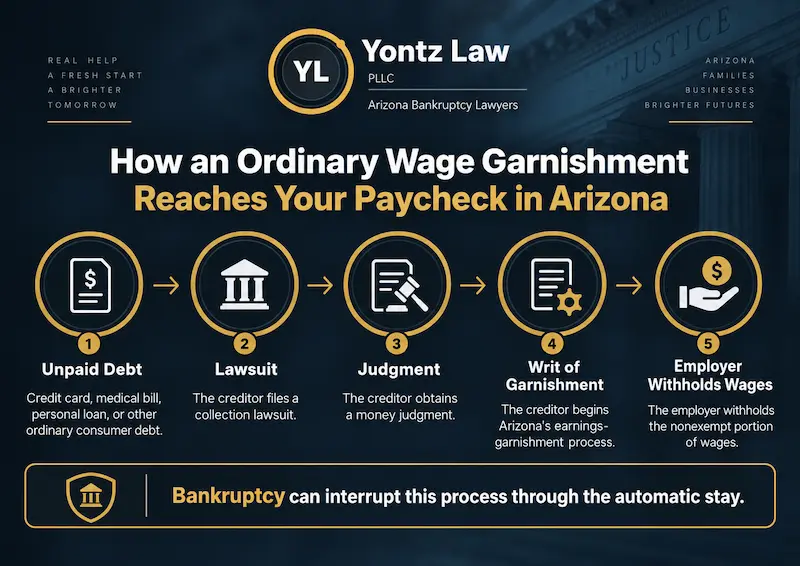
If your wages are being garnished in Arizona, there may be ways to stop or reduce the amount being taken from your paycheck. The right solution depends on the type of debt, whether a creditor already has a judgment, and how far the garnishment process has progressed.
For many ordinary judgment debts, filing Chapter 7 or Chapter 13 bankruptcy can stop an active wage garnishment. Filing a bankruptcy case generally triggers the automatic stay, which prevents most creditors from continuing collection actions, including wage garnishment.
Bankruptcy does not affect every type of garnishment in the same way. Child support and other domestic support obligations are subject to different rules, and special rules or exceptions may also apply to tax debts, student loans, government collection actions, prior bankruptcy filings, and other situations.
If money is already coming out of your paycheck, timing matters. The automatic stay generally takes effect when the bankruptcy case is filed, but the creditor and your employer still need to learn about the filing, and payroll timing can affect whether a deduction has already been processed.
Can a Debt Collector Garnish Your Wages in Arizona?
For most ordinary consumer debts, a debt collector generally must obtain a money judgment before using Arizona's wage-garnishment process. A collection letter or missed payment by itself does not ordinarily give a credit-card company, medical provider, or other judgment creditor the right to start taking money directly from your paycheck.
Most Ordinary Creditors Need a Judgment First
Arizona courts describe garnishment as a legal process used to collect money after a money judgment has been entered. For a typical consumer debt, that usually means the creditor first files a lawsuit and obtains a judgment before applying for a writ of garnishment directed to the debtor's employer.
The process often looks like this:
A debt goes unpaid. This might involve a credit card, medical bill, personal loan, or another consumer obligation.
The creditor or debt buyer files a lawsuit. The debtor has an opportunity to respond to the lawsuit and raise any available defenses.
The creditor obtains a money judgment. A judgment gives the creditor additional legal collection remedies that were not available merely because the debt was unpaid.
The judgment creditor applies for a writ of garnishment. Arizona law requires an application identifying, among other things, the judgment, the unpaid balance, and the employer or other entity believed to owe earnings to the debtor.
The employer is brought into the garnishment proceeding. The employer receives the garnishment papers and may be required to withhold the nonexempt portion of the employee's earnings.
If you have been sued but your wages are not being garnished yet, the lawsuit may still be important. Once a creditor obtains a judgment, wage garnishment may become one of the collection tools available to it. Learn more about how bankruptcy can affect lawsuit debt.
Your Employer Becomes Part of the Garnishment Process
In an earnings garnishment, the employer is the garnishee. Arizona law provides for a writ and summons to be issued to the garnishee, and the employer must respond to the garnishment proceeding and follow the applicable rules for withholding nonexempt earnings.
This distinction matters because an ordinary debt collector generally does not simply contact your employer and tell it to take part of your paycheck. Wage garnishment is a court-supervised collection process with specific procedures, notices, exemptions, and opportunities to request a hearing. Different rules can apply to obligations such as child support, taxes, and certain government debts, which are discussed separately below.
The Arizona Judicial Branch provides current information and forms for garnishment proceedings in Arizona. The statutory procedure for applying for and issuing an earnings garnishment writ is set out in A.R.S. §§ 12-1598.03 and 12-1598.04.
How Much of Your Paycheck Can Be Garnished in Arizona?
For most ordinary judgment debts, an Arizona creditor cannot simply take 25% of your paycheck. Arizona law generally provides stronger protection for earnings. The amount that can be garnished is limited to the lesser of two calculations, which means the actual amount may be less than 10% of your disposable earnings.
Arizona Generally Protects Most of Your Disposable Earnings
Under A.R.S. § 33-1131, the maximum amount of disposable earnings subject to an ordinary wage garnishment for a workweek is the lesser of:
10% of your disposable earnings for the week; or
the amount by which your disposable earnings exceed 60 times the applicable minimum hourly wage.
For this calculation, Arizona law defines disposable earnings as the portion of wages, salary, commissions, bonuses, and certain other compensation remaining after amounts required by law to be withheld have been deducted.
The minimum wage portion of the formula uses the highest applicable federal, Arizona, or local minimum wage. That matters because some Arizona cities may have a minimum wage higher than the statewide rate.
Example: Calculating an Arizona Wage Garnishment
Assume an employee has $1,000 in disposable earnings for one workweek and the applicable minimum wage is Arizona's 2026 statewide rate of $15.15 per hour.
10% of $1,000 = $100.
60 × $15.15 = $909.
$1,000 − $909 = $91.
Arizona uses the lesser amount. In this example, the maximum ordinary wage garnishment would therefore be $91 for that workweek, not $100.
The calculation can change with income, pay frequency, and the applicable minimum wage. The 10% figure is therefore a ceiling for an ordinary judgment-creditor garnishment, not necessarily the amount that should be taken from every paycheck.
Arizona's Extreme-Hardship Rule May Reduce the Garnishment
Arizona law provides another potential protection when a 10% garnishment would create serious financial hardship. If the court finds, based on clear and convincing evidence, that the debtor or the debtor's family would suffer extreme economic hardship, the court may reduce the amount withheld from 10% to not less than 5% of disposable earnings.
The reduction is not automatic. The debtor must request relief and establish the required hardship. We will discuss the hearing process and other ways to challenge or reduce a garnishment later on this page.
Wage protections are one part of Arizona's broader exemption system. You can learn more about Arizona bankruptcy exemptions and how state law protects certain property and income.
The current earnings-garnishment limits are set out in A.R.S. § 33-1131, and Arizona's extreme-hardship provision appears in A.R.S. § 12-1598.10.
These limits apply to ordinary earnings garnishments. Different rules can apply to child support, taxes, and certain other obligations, so the type of garnishment should be identified before relying on the 10% limit.
Can Bankruptcy Stop Wage Garnishment in Arizona?
Yes, filing bankruptcy can stop many Arizona wage garnishments. When a Chapter 7 or Chapter 13 bankruptcy case is filed, federal law generally creates an automatic stay that prevents creditors from continuing most collection activity against the person who filed. For an ordinary judgment creditor, that generally includes continuing to garnish wages.
The Automatic Stay Usually Begins When the Bankruptcy Case Is Filed
The automatic stay comes from 11 U.S.C. § 362. In most bankruptcy cases, the stay takes effect when the bankruptcy petition is filed. A separate hearing or court order is not ordinarily required before the stay begins.
For someone whose wages are being garnished to collect an ordinary pre-bankruptcy judgment, this can be one of the most immediate protections bankruptcy provides. Once the stay applies, the judgment creditor generally cannot continue using the garnishment to collect that debt while the stay remains in effect.
Stopping the Garnishment and Eliminating the Debt Are Different Questions
The automatic stay addresses collection activity. Whether the underlying debt is ultimately discharged depends on the type of debt, the bankruptcy chapter, and the facts of the case. Many ordinary credit-card, medical-debt, and personal-loan judgments may be dischargeable, but not every debt is.
There are also exceptions and limitations to the automatic stay. For example, certain actions involving domestic support obligations are treated differently, and prior bankruptcy cases dismissed within the previous year can affect whether the stay lasts for the entire case or takes effect at all. We discuss these exceptions separately below.
The United States Courts explains that while the automatic stay is in effect, creditors generally may not continue lawsuits, wage garnishments, or other collection efforts. You can also read more about how bankruptcy affects creditor collection and the automatic stay.
Chapter 7 vs. Chapter 13 for Wage Garnishment
Both Chapter 7 and Chapter 13 can generally stop an ordinary judgment-creditor wage garnishment through the automatic stay. The better question is what happens after the garnishment stops. The right chapter depends on the type of debt, income, property, secured debts, and what you need the bankruptcy case to accomplish.
The Garnishment Usually Does Not Decide Which Chapter to File
If the automatic stay applies, both Chapter 7 and Chapter 13 can provide protection from an ordinary wage garnishment. Choosing between them usually requires looking at the larger financial picture, including whether the debt can be discharged, whether you need time to catch up on secured debts, what property you own, and whether you qualify for Chapter 7.
Chapter 7
Chapter 7 and Wage Garnishment
Chapter 7 may be a good fit when an ordinary wage garnishment is part of a broader problem with unsecured debt that can be discharged. Filing generally triggers the automatic stay, and a discharge can eliminate personal liability for many qualifying debts that caused the garnishment in the first place.
The garnishment generally stops while the automatic stay applies.
Many ordinary credit-card, medical, and personal-loan debts may be discharged.
Chapter 7 does not use a three-to-five-year repayment plan.
Income and the Chapter 7 means test can affect eligibility.
Arizona exemption law and the value of your property must be reviewed before filing.
Chapter 13 also generally stops an ordinary wage garnishment through the automatic stay, but instead of a Chapter 7 liquidation process, the debtor proposes a court-approved repayment plan that usually lasts three to five years.
The garnishment generally stops while the automatic stay applies.
A repayment plan can address multiple debts at the same time rather than treating the garnishment as an isolated problem.
Chapter 13 may allow a debtor to catch up on certain past-due secured obligations, such as mortgage or vehicle payments.
It may be considered when a debtor does not qualify for Chapter 7 or has property or financial goals that make Chapter 7 a poor fit.
The amount paid through the plan depends on several factors and is not simply equal to the amount that was being garnished.
A wage garnishment can create the urgency that leads someone to consider bankruptcy, but it should not be the only factor used to choose a chapter. An attorney should also review the debts behind the garnishment, income, property, secured loans, recent financial transactions, and the goals the person needs the bankruptcy case to accomplish.
How Quickly Does Wage Garnishment Stop After Filing Bankruptcy?
The automatic stay generally takes effect as soon as the bankruptcy case is filed, but an active wage garnishment may not disappear from payroll at that exact moment. The creditor and employer need to learn about the bankruptcy, and the timing of an upcoming payroll can affect whether a deduction has already been processed.
The Automatic Stay Takes Effect Upon Filing
In a typical Chapter 7 or Chapter 13 case, the debtor does not have to wait for a hearing or a separate court order before the automatic stay begins. Filing the bankruptcy petition generally activates the stay by operation of law. While the stay is in effect, an ordinary judgment creditor generally cannot continue using a wage garnishment to collect a pre-bankruptcy debt.
The District of Arizona Bankruptcy Court describes the automatic stay as stopping garnishments and other collection activity when the bankruptcy petition is filed. The federal authority for the stay is 11 U.S.C. § 362.
The Creditor and Employer Still Need to Learn About the Filing
That may include the judgment creditor, the creditor's attorney, and the employer or payroll department processing the garnishment. Providing the case number and filing information quickly can help close the gap between the legal protection created by the bankruptcy filing and the practical process of stopping payroll withholding.
Payroll Timing Can Affect the Next Paycheck
Employers often process payroll before the date an employee actually receives a paycheck. If payroll has already been calculated or transmitted when the bankruptcy is filed, a garnishment deduction may already be in motion. That does not change when the automatic stay legally began, but it can affect what appears on the next paycheck and what steps may be needed afterward.
Example: Filing Bankruptcy Just Before Payday
Suppose an employee's paycheck is issued on Friday, but the employer completes payroll processing on Tuesday. If the employee files bankruptcy on Wednesday, the automatic stay generally begins on Wednesday. However, the garnishment deduction for Friday's paycheck may already have been processed.
The next step may depend on whether the employer is still holding the money, whether it has already been sent to the creditor, and when each party received notice of the bankruptcy. That is why the timing of an active garnishment should be reviewed rather than assuming that filing will automatically change the next paycheck.
If wages continue to be withheld after a bankruptcy filing, the timing and destination of the money should be reviewed promptly. Money that has not yet left the employer's control can present a different issue from money that was transferred before or after the bankruptcy case was filed. We will address what can happen to wages already withheld later on this page.
Can You Stop Wage Garnishment Immediately in Arizona?
Sometimes, yes. The fastest way to stop or reduce a wage garnishment depends on the type of debt and where the garnishment is in the legal process. For many ordinary judgment debts, filing Chapter 7 or Chapter 13 bankruptcy may stop an active garnishment through the automatic stay. Other situations may call for challenging the garnishment, asking the court to reduce the amount being withheld, or resolving the judgment with the creditor.
There is no single way to stop every Arizona wage garnishment. Depending on the circumstances, the available options may include:
Filing bankruptcy. Filing a bankruptcy case generally triggers the automatic stay, which stops most ordinary judgment-creditor garnishments while the stay remains in effect.
Challenging the garnishment. A debtor may have grounds to object if, for example, the garnishment is invalid, the judgment has already been satisfied, or the amount being withheld has been calculated incorrectly.
Requesting a hardship reduction. Arizona law allows the court to reduce the amount withheld from earnings in qualifying cases when the debtor can establish extreme economic hardship.
Reaching an agreement with the creditor. A creditor may agree to release the garnishment as part of a settlement or other arrangement. A payment agreement by itself should not be assumed to stop an existing garnishment unless the creditor actually agrees to release it.
Resolving the underlying judgment. Under Arizona law, a continuing earnings garnishment can end when the judgment is satisfied, vacated or expires, when the creditor releases the garnishment, when the proceeding is stayed by a court, including a bankruptcy court, or when the court orders the garnishment quashed.
If wages are already being withheld, the important question is not simply whether the garnishment can be stopped. It is which option applies to your situation and how quickly it can take effect. Bankruptcy can act very quickly from a legal standpoint, but notice and payroll processing can still affect what happens to an upcoming paycheck.
Arizona's rules for continuing earnings garnishments and hardship reductions are found in A.R.S. § 12-1598.10.
Does Bankruptcy Stop Every Type of Wage Garnishment?
No. Different types of wage withholding are treated differently in bankruptcy. The automatic stay generally stops an ordinary judgment creditor from continuing to garnish wages for a pre-bankruptcy debt, but special rules apply to domestic support obligations, tax collection, student loans, and certain other government collection actions.
Ordinary Judgment-Creditor Garnishments
Wage garnishments based on ordinary consumer judgments are generally the clearest example of collection activity stopped by the automatic stay. This can include judgments arising from credit-card debt, medical debt, personal loans, and other dischargeable consumer obligations.
Stopping the garnishment does not automatically answer whether the underlying debt will be discharged, but many ordinary unsecured debts can be discharged in a successful bankruptcy case.
Child Support and Other Domestic Support Obligations
Domestic support obligations are different. Federal bankruptcy law expressly provides that the automatic stay does not stop the withholding of income under a judicial or administrative order or statute for payment of a domestic support obligation.
That means filing bankruptcy should not be assumed to stop a child-support withholding order. Domestic support obligations also receive special treatment throughout the Bankruptcy Code and generally are not discharged simply because a bankruptcy case is filed.
The domestic-support exception to the automatic stay is found in 11 U.S.C. § 362(b)(2).
Tax Levies and Wage Collection
Tax collection also requires separate analysis. An IRS levy on wages is not the same procedure as an Arizona judgment-creditor garnishment. Filing bankruptcy generally stops IRS collection enforcement, including levy activity intended to collect pre-bankruptcy tax liabilities, while the automatic stay remains in effect.
That does not mean the tax debt itself disappears. Some tax debts can be discharged if specific requirements are satisfied, while many others survive bankruptcy. Federal law also allows the IRS to continue certain activities during bankruptcy, including audits, tax assessments, and notices and demands for payment.
The IRS explains the effect of bankruptcy on tax collection in its Bankruptcy Tax Guide.
Student Loan Wage Garnishment
Federal student loans can also be collected through administrative wage garnishment, which is different from the Arizona judgment process discussed earlier on this page. A federal student-loan creditor does not necessarily need to obtain a court judgment before using that collection procedure.
Bankruptcy can generally stop covered student-loan collection activity while the automatic stay is in effect, but stopping collection and discharging the student-loan debt are two different questions. Student loans are not ordinarily eliminated by the standard bankruptcy discharge. A borrower seeking a bankruptcy discharge of qualifying student-loan debt generally must obtain a separate determination from the bankruptcy court.
A credit-card judgment garnishment, child-support withholding order, IRS wage levy, and federal student-loan administrative garnishment may all reduce a paycheck, but they do not operate under the same laws. Before relying on bankruptcy to stop withholding, identify who is taking the money and what debt is being collected.
The automatic stay can also be limited in some repeat bankruptcy filings, and a creditor may sometimes ask the bankruptcy court for relief from the stay. For those reasons, the fact that bankruptcy normally stops a particular collection action does not guarantee that the stay will provide the same protection in every case.
What Happens to Money Already Taken From Your Paycheck?
Filing bankruptcy can stop future covered garnishment activity, but it does not automatically mean that every dollar taken before the filing will be returned. What happens to money already withheld can depend on whether the employer is still holding it, whether it has already been transferred to the creditor, when the transfer occurred, and whether bankruptcy law provides a way to recover it.
Wages Withheld but Still Held by Your Employer
Under Arizona's earnings-garnishment procedure, there can be a period when an employer has withheld nonexempt earnings but has not yet transferred the money to the judgment creditor. Arizona law provides that, before the required court order is entered, the employer generally may not remit those withheld earnings to the creditor.
After a continuing lien is entered, the employer generally sends the nonexempt earnings to the creditor for each pay period while the lien remains in effect. Arizona law also provides that a continuing earnings lien becomes invalid and has no further force when the garnishment proceedings are stayed by a court of competent jurisdiction, including a United States bankruptcy court.
For that reason, if bankruptcy is filed while an employer is holding garnished wages, it is important to determine exactly where the money is before assuming that it has already been lost.
Money Transferred to the Creditor Before Bankruptcy
Money that reached the creditor before the bankruptcy filing presents a different question. Filing bankruptcy does not automatically reverse every payment the creditor received before the case began.
In some cases, however, recently garnished wages may need to be reviewed under the Bankruptcy Code's rules governing preferential transfers. Section 547 allows certain transfers made to creditors before bankruptcy to be avoided when all of the statutory requirements are satisfied. The lookback period for an ordinary creditor is generally 90 days before the bankruptcy filing.
That does not mean that every debtor can simply demand the return of all wages garnished during the previous 90 days. Preference law contains additional requirements, defenses, and limitations. Whether the debtor can personally recover transferred funds can also depend on exemption rights, whether the bankruptcy trustee acts, and the requirements of 11 U.S.C. § 522.
Example: The Timing of the Garnishment Can Change the Analysis
Assume an employer withholds $150 from an employee's paycheck shortly before the employee files bankruptcy. If the employer is still holding the money when the case is filed, the legal issues may be different from a situation where the $150 was transferred to the judgment creditor before the bankruptcy filing.
If money was transferred before bankruptcy, the next question may be whether bankruptcy law provides a basis to recover that transfer. If money is transferred after the bankruptcy filing, the automatic stay may raise a different set of issues.
What If Money Is Taken After the Bankruptcy Is Filed?
If an ordinary judgment-creditor garnishment continues after the bankruptcy filing, the situation should be reviewed promptly. The automatic stay generally prohibits continued collection of a covered pre-bankruptcy debt, but the facts still matter, including when the wages were earned, when they were withheld, when they were transferred, and when the creditor and employer learned of the bankruptcy.
This is why it is useful to keep the pay stub showing the garnishment and any garnishment notices you received. Those records can help determine exactly what happened to the money and when.
Can You Challenge or Reduce a Wage Garnishment Without Bankruptcy?
Yes, in some circumstances. Bankruptcy can be an effective way to stop an ordinary wage garnishment when the garnishment is part of a larger debt problem, but it is not the only possible remedy. Arizona law allows a debtor to request a hearing to challenge certain aspects of a garnishment, and qualifying debtors may ask the court to reduce the amount withheld because of extreme economic hardship.
You Can Request a Garnishment Hearing
Arizona's earnings-garnishment procedure gives the judgment debtor the right to object to the writ of garnishment, the employer's answer, or a statement showing the amount of nonexempt earnings being withheld.
In general, a request for hearing must be filed within 10 days after receiving the answer or nonexempt earnings statement being challenged, unless the court finds good cause for a later request. Arizona law calls for the hearing to begin promptly after the court receives the request.
You May Be Able to Challenge the Garnishment or Amount Being Withheld
A garnishment hearing is not simply a general opportunity to argue that a debt is difficult to pay. The objection should identify a legal or factual problem with the garnishment, the judgment, the employer's answer, or the amount being withheld.
Depending on the facts, issues raised at a hearing may include:
The creditor does not have a valid judgment.
The judgment has already been paid or satisfied.
The employer's garnishment answer is incorrect.
The amount of nonexempt earnings has been calculated incorrectly.
The wages are already subject to another garnishment or court-ordered support assignment.
An exemption or another legal objection applies.
Arizona's statutory hearing form specifically identifies several of these grounds and allows the debtor to state another basis for requesting a hearing. The court can then determine issues such as whether the writ is valid, the amount still owed on the judgment, and whether the employer owes earnings subject to the garnishment.
You May Be Able to Ask for an Extreme-Hardship Reduction
Arizona also provides a limited hardship remedy. If the debtor is otherwise subject to the 10% maximum garnishment and proves by clear and convincing evidence that the garnishment would cause extreme economic hardship to the debtor or the debtor's family, the court may reduce the amount withheld.
The court may reduce the withholding from 10% of disposable earnings to an amount not less than 5%. The reduction is not automatic simply because paying household expenses has become difficult. The debtor must request relief and provide enough evidence for the court to make the required hardship finding.
Example: When a Hardship Request May Be Worth Exploring
Suppose an Arizona worker is subject to a 10% ordinary wage garnishment and the loss of that income leaves the household unable to cover essential expenses such as housing, utilities, food, or necessary medical costs. That does not automatically reduce the garnishment, but it may be a reason to investigate whether the worker can establish the extreme economic hardship required by Arizona law.
When a Nonbankruptcy Solution May Make More Sense
Bankruptcy is not automatically the best answer merely because a wage garnishment exists. If the garnishment is legally defective, the judgment has been satisfied, the withholding calculation is wrong, or a focused agreement with the creditor can realistically solve the problem, a nonbankruptcy remedy may be enough.
On the other hand, if the garnishment is only one part of a larger financial problem involving multiple debts, lawsuits, collection accounts, or other payment obligations, stopping a single garnishment may not solve the underlying problem. That is when it becomes especially important to compare the available nonbankruptcy remedies with what a bankruptcy case could accomplish.
When Should You Talk With an Arizona Wage Garnishment Attorney?
You do not have to wait until several paychecks have already been garnished to get legal advice. If a creditor has obtained a judgment, your employer has received garnishment papers, or money is already being withheld, an attorney can help determine what kind of garnishment is involved and which options are realistically available.
It may be especially helpful to speak with an Arizona bankruptcy attorney when:
Your employer has received a wage-garnishment notice or writ. Understanding the paperwork can help determine what stage the garnishment has reached and whether any deadlines are approaching.
Money is already being taken from your paycheck. The amount being withheld, where the money is in the garnishment process, and the timing of your next payroll can all matter.
A creditor recently obtained a judgment against you. A judgment can give an ordinary creditor additional collection remedies, including the ability to pursue wage garnishment.
You believe the garnishment or withholding amount may be wrong. Arizona provides procedures for challenging certain garnishment issues and requesting a hearing.
You are struggling with more than the garnishment itself. Credit-card balances, medical bills, lawsuits, vehicle debt, mortgage arrears, or other collection problems may mean that resolving one garnishment will not solve the larger financial problem.
You are considering bankruptcy anyway. If Chapter 7 or Chapter 13 may already be under consideration, an active garnishment can make the timing of that decision more important.
You are not sure what kind of garnishment is taking your wages. Ordinary judgment debt, child support, tax collection, and student-loan garnishment can involve very different rules.
Look at the Garnishment and the Larger Financial Picture
Stopping money from coming out of the next paycheck may be the immediate concern, but a useful legal review should go further. The underlying debt, household income, other collection activity, property, secured debts, and longer-term financial goals can all affect whether bankruptcy or a nonbankruptcy solution makes more sense.
Casey Yontz has more than 18 years of bankruptcy experience helping Arizona individuals and families address wage garnishments, creditor lawsuits, unsecured debt, and other collection problems. Learn more about Casey Yontz and Yontz Law.
Helpful Information to Have for a Garnishment Review
You do not need perfect records before asking for help. If available, it can be useful to have:
Your most recent pay stub showing the garnishment.
Any writ, notice, or other garnishment papers you received.
The lawsuit or judgment, if you have it.
The name of the creditor or collection attorney.
A basic list of your other debts and monthly obligations.
Those documents can help identify the type of garnishment, how much is being withheld, and whether the garnishment is part of a larger debt problem that should be addressed.
Wages Already Being Garnished?
Talk with Yontz Law about what is causing the garnishment, whether the amount being withheld appears correct, and what options may be available to stop or reduce it. Casey can also help you evaluate whether Chapter 7, Chapter 13, or a nonbankruptcy solution makes sense for your broader financial situation.
If another paycheck is approaching, mention the active garnishment when you contact the firm so the timing can be reviewed along with the underlying debt.
We work with individuals and families in the Phoenix metro area and in communities across Arizona. In office, phone and virtual appointments are available. Choose a city below to find local bankruptcy guidance, common issues we often see in that area, and practical next-step resources.